Cholesterol Test (Lipid Profile) in Chandigarh: Normal Ranges, Fasting and When to Test
High cholesterol does not hurt, itch or show up on your skin. You can feel completely well while fats slowly build up inside your arteries, and for many people the first sign is a heart attack or stroke. That is why a simple blood test, the lipid profile, is one of the most useful checks you can have.
This guide explains what a lipid profile measures, what the numbers mean, whether you need to fast, who should be tested and how often, and what actually helps lower cholesterol.
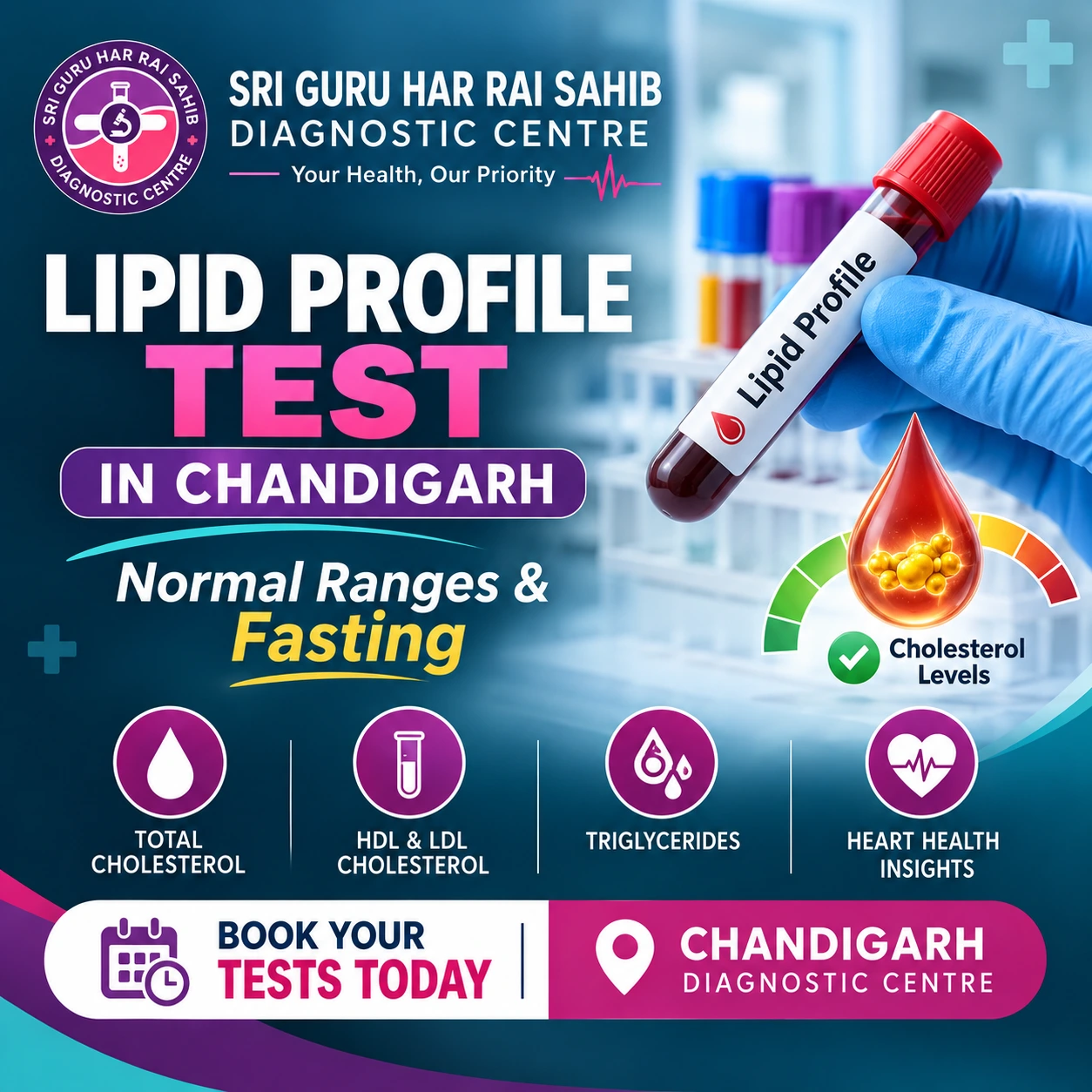
A lipid profile is a blood test that measures total cholesterol, LDL ("bad") cholesterol, HDL ("good") cholesterol and triglycerides. Desirable levels are generally total cholesterol below 200 mg/dL, LDL below 100 mg/dL, triglycerides below 150 mg/dL and HDL as high as possible, but your doctor sets your own target based on your risk. Fasting rules vary, so follow the instructions you are given when you book.
What Is Cholesterol? LDL, HDL and Triglycerides Explained
Cholesterol is a waxy substance in your blood. Your body needs some of it to build healthy cells, but too much raises your risk of heart disease because it can build up as plaque in the walls of your arteries. A lipid profile looks at several kinds of blood fat:
- LDL cholesterol ("bad"): carries cholesterol to your tissues and contributes to plaque in the arteries
- HDL cholesterol ("good"): removes extra cholesterol and carries it back to the liver
- Triglycerides: a type of blood fat. High levels also raise heart disease risk
- VLDL and non-HDL cholesterol: other measures of the harmful fats. Non-HDL is the total of your harmful forms, including LDL and VLDL
What Does a Lipid Profile Measure? Normal Ranges
Here are the desirable levels used by many labs, based on NCEP guidelines. All values are in mg/dL.
| Measure | Desirable Level | What It Means |
|---|---|---|
| Total cholesterol | Below 200 | The overall amount of cholesterol in your blood |
| LDL ("bad") | Below 100 for most people. Lower targets apply if your risk is higher | Higher levels mean more plaque risk. Your doctor may aim for below 70, or even below 55, if you are at high or very high risk |
| HDL ("good") | 60 or above is optimal. Below 40 (men) or below 50 (women) is considered low | Higher is better, because HDL clears excess cholesterol |
| Triglycerides | Below 150 | High levels are linked with obesity, diabetes and metabolic problems |
| Non-HDL cholesterol | Below 130 | Combines all the harmful forms |
Ranges can differ slightly between labs and guidelines, and your report will show the reference range used. A number outside the range is a reason to talk to your doctor, not to panic. They will read your lipid profile together with your age, blood pressure, blood sugar, family history and whether you smoke.
High Cholesterol Symptoms: Why Waiting for Signs Is Risky
High cholesterol usually causes no symptoms at all. A blood test is the only way to detect it. By the time chest pain, breathlessness or a stroke appears, the arteries may already be badly affected. This is why doctors recommend testing based on your risk, not on how you feel.
What Causes High Cholesterol?
Lifestyle is the most common cause, but not the only one:
- A diet high in saturated and trans fats, such as fried food, bakery items, ghee and butter in excess, and processed snacks
- Too little physical activity and extra weight, especially around the belly
- Diabetes, an underactive thyroid (hypothyroidism), and chronic kidney or liver disease
- Family history, including inherited conditions such as familial hypercholesterolemia
- Smoking and heavy alcohol use
- Some medicines, including certain diuretics, beta-blockers, steroids and estrogens
- Age: cholesterol tends to rise with age, and in women after menopause
Because thyroid problems and diabetes can raise cholesterol, doctors often test them together. See our guides to thyroid tests in Mohali, thyroid test symptoms and diabetes tests in Chandigarh.
Who Should Get a Lipid Profile, and How Often?
Many labs suggest a routine check for adults from around age 35, and earlier if you have risk factors. You should get tested sooner if you:
- Have diabetes, high blood pressure or a thyroid disorder
- Are overweight, have a large waist or lead a sedentary life
- Smoke or drink heavily
- Have a family history of heart disease, stroke or high cholesterol
- Are already on cholesterol medicine and need to monitor it
- Have chest discomfort, unexplained tiredness or dizziness (see a doctor too)
How often to repeat the test depends on your results. Adults with normal levels and low risk are often retested every few years, while people with risk factors, abnormal results or cholesterol medicines may need a check every 6 to 12 months. Your doctor will advise your own schedule.
How to Prepare for a Lipid Profile Test
Fasting advice varies. Some lipid tests do not need fasting, while many labs ask for a fast of roughly 9 to 14 hours, with plain water only. Follow the instructions given when you book. In general:
- Drink only plain water during the fast. Water is fine and helps
- Avoid alcohol for at least 24 hours before the test
- Avoid strenuous exercise before the test
- Keep taking your regular medicines unless your doctor tells you otherwise
- Tell the lab if you are on cholesterol medicine or have been unwell recently
For more on fasting and non-fasting tests, read our guide to blood test instructions: fasting vs non-fasting.
How to Lower Cholesterol
Lifestyle changes are the foundation of treatment, whatever your numbers:
- Eat heart-healthy: more vegetables, fruit, whole grains, legumes, nuts and lean protein, and use healthy oils in small amounts
- Cut back on: saturated fat, trans fat, added sugar, salt and processed food
- Move more: aim for at least 150 minutes a week of brisk activity such as walking, cycling, swimming or yoga
- Reach a healthy weight: even modest weight loss can improve your numbers
- Quit smoking and limit alcohol
- Sleep well and manage stress
When Are Medicines Needed?
If your risk of a heart attack or stroke is high, or lifestyle changes are not enough, your doctor may prescribe medicine. Statins are the most common choice, and there are other options. Medicines are always used together with lifestyle changes, never instead of them.
Do not start or stop cholesterol medicine on your own. If you take a statin, report side effects such as muscle pain to your doctor, who may also ask for blood tests, including a liver function test, to monitor you.
Tests That Often Go with a Lipid Profile
Cholesterol is one part of your heart risk. Doctors often check these together:
- Blood sugar and HbA1c, to look for diabetes
- Thyroid tests (TSH), since an underactive thyroid can raise cholesterol
- Liver function test (LFT) and kidney function test (KFT)
- ECG and echocardiography, if you have symptoms or high risk
Read more in our guides to the best cardiac diagnostic tests for early heart disease, a heart health checkup in Chandigarh, the kidney function test in Mohali and annual blood tests every adult should know. You can also see our CBC test in Chandigarh page.
Lipid Profile and Health Checkup Packages at SGHRSDC
A lipid profile can be done on its own or as part of a health checkup. For individual test prices, see our Rate List or call our helpline. If you would like several markers checked at once, our preventive packages are a simple option. Open each package's details page to see which tests it includes, such as lipid profile, blood sugar and liver function tests.
| Package | Price | Tests |
|---|---|---|
| Basic Health Package | ₹500 | 7 tests |
| Preferred Health Package | ₹600 | 8 tests |
| Essential Health Package | ₹1,200 | 10 tests |
| Advance Health Package | ₹1,500 | 14 tests |
Prices are as listed on our packages page in October 2026 and may change. Not sure whether a package or individual tests suit you better? Read our guide to full body checkup vs individual blood tests.
Get Your Cholesterol Test in Chandigarh, Mohali, Zirakpur, Kharar and Panchkula
Sri Guru Har Rai Sahib Diagnostic Centre is an NABL accredited lab serving Chandigarh, Mohali, Kharar, Zirakpur and Panchkula, with automated analysers for accurate results.
- Home sample collection: book from home and let our team come to you
- Online reports: download your reports online
- Lab timings: Monday to Saturday 7:00 AM to 7:00 PM. Sunday 7:00 AM to 2:00 PM at selected centres (Chandigarh Sector 22, Kharar, Dhakoli, Phase 7 Mohali and Mullanpur)
- 24/7 helpline: +91 70870 00023
Book your lipid profile or health checkup or find your nearest centre on our branches page. You may also like our guide to the best blood test in Chandigarh and our guide to reading your blood test report.
Frequently Asked Questions About Cholesterol and the Lipid Profile
It depends on the test and the lab. Some lipid tests do not need fasting, while many labs ask for a fast of about 9 to 14 hours with plain water only. Follow the instructions given when you book, and avoid alcohol for 24 hours beforehand.
Generally, total cholesterol below 200 mg/dL, LDL below 100 mg/dL, triglycerides below 150 mg/dL and HDL of 40 mg/dL or more (60 or above is optimal). Your doctor may set a lower LDL target if your heart risk is higher.
Usually not. It is typically silent, so a blood test is the only way to know. Do not wait for chest pain or breathlessness before getting checked.
LDL is called "bad" cholesterol because it contributes to plaque in your arteries. HDL is called "good" because it helps remove cholesterol from your blood. Triglycerides are a separate blood fat, and high levels also raise heart risk.
Often it can be improved a lot with diet, exercise, weight loss, quitting smoking and limiting alcohol, especially if levels are only mildly raised. If your risk is high, your doctor may add medicine alongside these changes.
Adults with normal levels and low risk are often retested every few years. If you have diabetes, high blood pressure, a family history, abnormal results or take cholesterol medicine, you may need a check every 6 to 12 months. Your doctor will advise you.
Yes. An underactive thyroid (hypothyroidism) can raise cholesterol, which is why doctors often check thyroid function when cholesterol is high.
See our Rate List for the individual test price, or call +91 70870 00023. Our preventive health packages start at ₹500, and each package's details page lists the tests it includes.
Final Word: Know Your Numbers Before Your Heart Tells You
Cholesterol is silent, but it is also one of the easiest heart risks to measure and to improve. A single blood test can show where you stand, and small, steady changes to food, movement and habits can make a real difference.
Book your lipid profile today and get accurate reports from a NABL accredited lab near you.