Dengue Season in Tricity: Symptoms, Warning Signs and Which Test to Take
Dengue season in the Tricity does not end when the monsoon does. Mosquito breeding peaks in the weeks after the rains, and in past seasons the health departments of Chandigarh, Mohali and Panchkula have kept reporting fresh dengue cases well into November, even after temperatures dropped.
If you or someone in your family has a fever right now, the real question is not just "is it dengue?" but "which test should I take, and on which day?" Testing on the wrong day can give a misleading negative result. This guide explains dengue symptoms, the right test for each day of fever, what your platelet count means, the warning signs that need a hospital, and where to get tested in Chandigarh, Mohali, Zirakpur, Kharar and Panchkula.
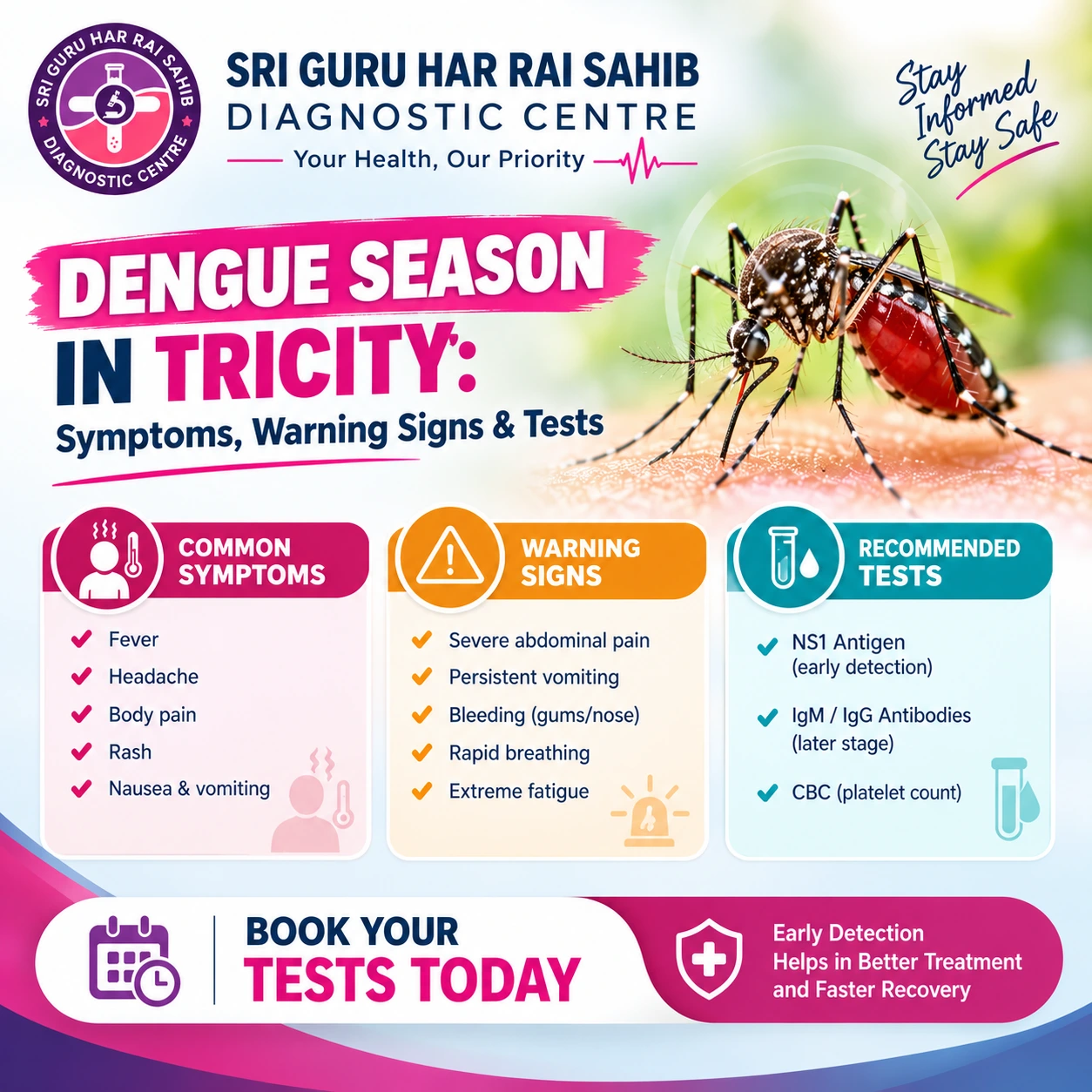
Get tested if fever lasts more than 2 days during dengue season, or sooner if you have severe body ache, pain behind the eyes or a rash. The dengue NS1 antigen test works best on days 1 to 5 of fever, the IgM antibody test from about day 5, and a CBC (complete blood count) tracks your platelets throughout.
Why Dengue Cases Rise in Chandigarh, Mohali and Panchkula After Monsoon
Dengue spreads through Aedes mosquitoes, which breed in clean, stagnant water. After the monsoon, water collects in desert coolers, flower pot trays, discarded tyres, water tanks, AC trays and construction sites. These are common across the Tricity's dense housing and new development in Mohali, Zirakpur, Kharar and Dera Bassi.
Unlike many mosquitoes, Aedes bite mainly during the day, in the early morning and late afternoon. Symptoms usually begin 4 to 10 days after the bite, so a person can fall ill well after the rains have stopped.
Dengue Symptoms: How to Recognise Them
Dengue often starts like any viral fever, which is why many people wait too long to get tested. Watch for these signs:
- Sudden high fever
- Severe headache, especially pain behind the eyes
- Intense body, muscle and joint pain (dengue is sometimes called "breakbone fever")
- Extreme tiredness, nausea and vomiting
- A red or spotty skin rash in some people
- Mild bleeding such as nosebleeds, bleeding gums or easy bruising
The fever usually lasts 2 to 7 days. Most people recover with rest, fluids and medical monitoring, but a few develop severe dengue, which is why testing and follow-up matter.
Dengue, Malaria, Typhoid or Chikungunya?
These illnesses overlap, and doctors rarely tell them apart by symptoms alone. Dengue and chikungunya are often reported together in the Tricity, and malaria and typhoid are common in the monsoon months.
| Illness | Common Clues | Usual Tests |
|---|---|---|
| Dengue | Sudden high fever, pain behind the eyes, severe body ache, low platelets | NS1 antigen, IgM/IgG, CBC |
| Malaria | Fever with chills and sweating, often in cycles | Rapid Malaria Test |
| Typhoid | Fever that builds over several days, stomach discomfort, loss of appetite | Widal, Typhi Dot |
| Chikungunya | Fever with severe joint pain and swelling | Chikungunya IgM/IgG |
| Other Viral Fever | Fever with cold, cough or sore throat | CBC and doctor's assessment |
Because of this overlap, doctors often order several tests together. Read more in our guide to common monsoon diseases and the tests you need and our malaria test guide.
Warning signs often appear around the time the fever starts to settle, usually between day 3 and day 7. A falling temperature is not always a sign of recovery, so stay alert even if you feel a little better.
Go to a hospital emergency department straight away if you notice:
- Severe or constant stomach pain
- Repeated vomiting, or being unable to keep fluids down
- Bleeding from the nose or gums, blood in vomit, or black or bloody stools
- Extreme weakness, drowsiness, restlessness or irritability
- Cold, clammy or pale skin
- Fast breathing or difficulty breathing
- Very little urine, or dizziness and fainting on standing
Do not wait for a lab report if you see these signs.
Which Dengue Test to Take on Which Day of Fever
The right dengue test depends on how many days you have had fever:
| Day of Fever | Best Test | Why |
|---|---|---|
| Day 1 to 5 | Dengue NS1 antigen (with CBC) | Detects a protein released by the virus while it is in your blood |
| From about Day 5 | Dengue IgM antibody (with IgG) | Antibodies appear as your body responds to the infection |
| Any Day | CBC with platelet count and PCV | Tracks platelets and blood concentration so your doctor can watch the trend |
Get tested if:
- Fever lasts more than 2 days during dengue season
- Fever comes with severe body ache, pain behind the eyes or a rash
- Someone in your home or neighbourhood has been diagnosed with dengue
- Your doctor advises it, even if the fever is mild
A negative NS1 result late in the illness (day 6 or 7) does not rule out dengue, because the antigen fades as antibodies rise. That is why labs often run NS1, IgM and IgG together, and why your doctor may repeat a test. Do not wait for your platelets to fall before testing.
Dengue Tests Explained
Dengue NS1 Antigen Test
NS1 is a protein produced by the dengue virus itself. The test detects it directly in your blood, so it can confirm infection in the first days of fever, before your body has made antibodies. It works best on days 1 to 5.
Dengue IgM and IgG Antibody Tests
IgM antibodies show a recent or current infection and are most useful from about day 5 of fever. IgG antibodies appear later and usually point to a past infection or a later stage of illness. A positive IgG with no IgM usually suggests an old infection. Tell your doctor if you have had dengue before, because a second infection can be more severe.
CBC and Platelet Count in Dengue
Platelets help your blood clot. The normal range is about 150,000 to 450,000 per microlitre of blood (1.5 to 4.5 lakh). In dengue, platelets often drop between days 3 and 7 and then recover as the fever settles.
The number alone does not define how serious the illness is. Doctors look at the trend over several days, your PCV (packed cell volume) and your symptoms. Our CBC report includes platelet count, PCV, MPV, PCT and PDW. If you want to understand your numbers, see our guide to reading a blood test report and our CBC test in Chandigarh page.
Dengue and Fever Test Packages at SGHRSDC: Names and Prices
We offer three fever packages. Please note that the ₹330 Basic Fever Package does not include a dengue test.
| Package | Price | Tests Included | Dengue Included? |
|---|---|---|---|
| Basic Fever Package | ₹330 | CBC (including platelet count and PCV), Rapid Malaria Test, Widal Test (Slide), ESR. 25 parameters. | No |
| Essential Fever Package | ₹1,350 | CBC, Rapid Malaria Test, Widal Test (Slide), Dengue NS1, IgM and IgG by fluorescence immunoassay, ESR. 28 parameters. | Yes |
| Advanced Fever Package | ₹2,300 | CBC, ESR, Urine R/E, Widal Test (Slide), Dengue NS1, IgM and IgG, CRP (quantitative), Typhi Dot, SGOT (AST), SGPT (ALT), Rapid Malaria Test, Chikungunya IgM and IgG, Reticulocyte Count. 52 parameters. | Yes, plus chikungunya |
Which package may suit you? Your doctor can guide the final choice:
- Basic Fever Package: a first screen for fever, covering platelets, malaria, typhoid and inflammation. Your doctor can add dengue tests if dengue is suspected.
- Essential Fever Package: a good fit for fever during dengue season, as it combines dengue NS1, IgM and IgG with CBC, malaria and typhoid screening.
- Advanced Fever Package: useful for fever that persists or when symptoms overlap, as it adds chikungunya, typhoid, CRP, liver enzymes (SGOT and SGPT) and a urine test.
Prices are as listed on our packages page in October 2026 and may change. For individual test prices, see our Rate List. Not sure how to prepare? Read our blood test instructions guide. No fasting is usually needed for dengue tests, but follow the instructions given at booking.
What to Do If You Have Fever During Dengue Season
- See a doctor and get tested within 2 to 3 days of fever, or earlier if you have severe body ache, eye pain or a rash
- Rest and drink plenty of fluids such as water, ORS, coconut water and soups
- Take paracetamol only as advised by your doctor
- Avoid aspirin and ibuprofen or other painkillers of that type unless your doctor prescribes them, as they can increase bleeding risk
- Do not start antibiotics on your own, since dengue is a viral infection
- Sleep under a mosquito net or use repellent while ill, so mosquitoes do not spread the infection to others in your home
- Get follow-up blood tests as advised, even after the fever ends
How to Prevent Dengue at Home in the Tricity
- Keep one "dry day" every week: empty and scrub coolers, buckets, flower pot trays and AC trays
- Cover water tanks and storage containers tightly
- Throw away old tyres, cans and containers that collect rainwater
- Use mosquito nets, window screens and repellents, especially in the morning and late afternoon
- Wear full-sleeved clothes when outdoors
- Support fumigation drives and inspections in your colony or society, and report stagnant water
Get Your Dengue Test in Chandigarh, Mohali, Zirakpur, Kharar and Panchkula
Sri Guru Har Rai Sahib Diagnostic Centre is an NABL accredited lab serving Chandigarh, Mohali, Kharar, Zirakpur and Panchkula, with automated analysers for accurate results.
- Home sample collection: book from home and let our team come to you
- Online reports: download your reports online
- Lab timings: Monday to Saturday 7:00 AM to 7:00 PM. Sunday 7:00 AM to 2:00 PM at selected centres (Chandigarh Sector 22, Kharar, Dhakoli, Phase 7 Mohali and Mullanpur)
- Helpline: +91 70870 00023
Book your dengue test or fever package or find your nearest centre on our branches page. Living in Zirakpur? See our page on the diagnostic centre in Zirakpur with home collection.
Want a deeper look at dengue testing and platelets? Read our earlier guide on the dengue test, symptoms and platelet count in Mohali.
Frequently Asked Questions About Dengue in the Tricity
Cases typically rise after the monsoon, from around September, and can continue into November. Mosquitoes breed in stagnant water, so risk stays high until nights turn consistently cold.
The dengue NS1 antigen test is usually the best choice in the first 5 days of fever. A CBC with platelet count is often done alongside it.
Yes. If NS1 is done very early or after day 5 to 7, it can miss the infection. Your doctor may repeat the test or add IgM and IgG antibody tests.
No. Platelets often fall and then recover during dengue. Doctors judge severity from the trend, PCV and symptoms, not from one number.
No fasting is usually required for dengue NS1, IgM, IgG or CBC. Follow the instructions given when you book.
Yes. You can book home sample collection through our contact page or call our helpline at +91 70870 00023.
Our Essential Fever Package at ₹1350 includes Dengue NS1, IgM and IgG along with CBC, Rapid Malaria Test, Widal and ESR. The Advanced Fever Package at ₹2300 also adds chikungunya. See the Rate List for individual test prices.
Final Word: Test Early, Stay Safe This Dengue Season
During dengue season in the Tricity, an unexplained fever deserves a test, not a wait-and-watch. Pick the right test for the right day, watch for warning signs as the fever settles, and keep your surroundings free of stagnant water.
Book your dengue test today and get accurate reports from a NABL accredited lab near you.